

Pat Shuman
TCC Board member, Foundation Board member, employee, and student
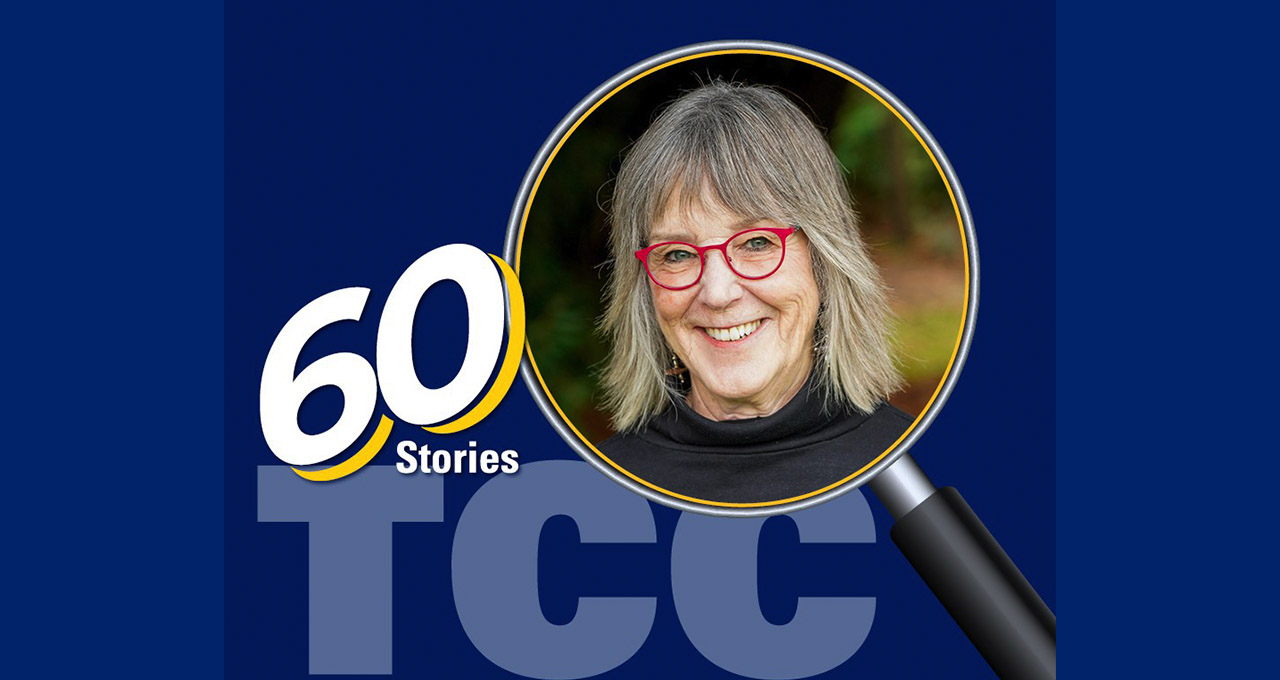
I love the people who work here. I am grateful for the gift of their trust and for the opportunity to participate so fully. The college, the students, and my TCC colleagues have brought a tremendous amount of meaning and enrichment to my life."
Pat Shuman has been a part of the TCC community since she started at the college in 1976. Since then she’s been an employee, a student, a member of the TCC Foundation Board, and a member of the Board of Trustees. Few people have experienced the college from such a varied set of perspectives.
A New Start in a New State
Born in Nashua, New Hampshire, Shuman graduated from the University of New Hampshire and moved to Washington. Dean of Students Dick Batdorf hired her be the “Home and Family Life Coordinator,” which included leading TCC’s original Childcare Center, located across 19th street in the basement of Fircrest Methodist Church.
“Every Monday we had to get all the furniture out and put it up, and on Fridays we had to put everything away so the church could use the space,” Shuman recalled.
Shuman also helped to launch the “Home and Family Life” vocational program, which offered classes such as “The Consumer in the Marketplace,” focused on helping students manage their money. A young single parent herself, Shuman found it easy to relate to the students who used the childcare center while attempting to complete their degrees.
“It took me eight years to get a BA, so I could really identify with our students,” Shuman said. “I often spoke with women students who were also parents, about their fears of not being able to make it. I knew they could, because I’d done it myself.”
As a result of her program development work, Shuman moved into the Student Leadership team as Director of Admissions, which she now feels was “not a great fit for my youth and inexperience.” Her job was eliminated during the brutal cuts necessitated by the early 1980s recession, but though she’d only been at the college for four or five years, TCC made a lasting impact on her.
“I’d moved here from New Hampshire, where I wasn’t aware of a system that prepared adults for work and life,” Shuman said. “The people who came to TCC were there for a specific reason. They wanted to get their degrees and get going on their lives. I always thought education should support your ability to have a successful life, and the community college system did it really well.”
While at TCC, Shuman started working on a Master’s degree in occupational education through Central Washington University.
“I was going to classes with other people working in education, and it was my first opportunity to start networking beyond TCC,” Shuman recalled. “I had two kids, I was a single mom, and it was really hard to pursue more education.”
Working at Weyerhaeuser
After the layoff, Shuman was hired as a regional leader of the federally funded program ACCTion, which provided support to community colleges nationwide. The program’s western regional office was located at Lower Columbia Community College, so she moved to Longview. During her brief time in that role she provided technical assistance to two-year colleges, and travelled all over the country. But the program’s funding was cut not long after she began the job. She moved back to Tacoma and accepted a position with Weyerhaeuser Company, where she would stay for the next 20 years, leading organizational development, leadership development, and corporate education.
“It wasn’t just about educating people, it was about implementing change, and of course you do that through people,” Shuman said. “I designed training programs on a wide range of topics. The idea was that people achieve when they know how to do their jobs. When people achieve, the company achieves.”
Among other things, Shuman led classes in a leadership development program for senior management. She taught vice presidents how to give performance reviews, handle difficult behavior, and lead problem-solving meetings.
“I loved the work,” Shuman said. “For me, helping adults learn and be successful was a great pleasure – it’s so cool that you can learn and grow while you’re on the job.”
It occurred to Shuman that community colleges could help with professional development work, and she made several attempts to partner with colleges on corporate education. But it never worked out very well.
“Corporate didn’t understand education, and vice versa. They didn’t understand the world of work at all.”
However, she and former TCC administrator Wayne Williams launched a briefly successful program, an out-placement center for former Puget Sound Bank employees who had been displaced by the acquisition of PSB by Key Bank. Many had little or no college, and needed education and skills to prepare for their next job. The center was in a building TCC occupied across Broadway from Tacoma’s Pantages Theater.
“It was the coolest damn thing, a wonderful blending of need and resources,” Pat recalled. “Wayne and I were very proud of it. But when one or the other of us left our job, the vision fell apart, and the center closed.”
At Weyerhaeuser Shuman met her late husband Dave Edwards, who worked in the Treasurer’s department. To her chagrin, he was appointed to the TCC Board of Trustees.
“He had two degrees from Stanford, he didn’t know what a community college was, and he didn’t care,” Shuman recalled. “I told him they had asked the wrong one!”
Shuman soon brought Edwards up to speed on the purpose and function of the community college system. During his tenure as a trustee, she assumed the role of “kitchen trustee,” helping him understand the quirks of community college culture, and why things that worked in business might not work in a college.
“He was a great Trustee,” Shuman said. “He brought a welcome business sense, and the perspective of an outsider who wasn’t in the boiling water at the college. I was proud of him and often envious.”
A TCC Student
When she retired from Weyerhaeuser, Shuman decided to take up art. TCC seemed the logical starting point for that pursuit, and she signed up for Beginning Painting. She took a painting class every quarter for more than 5 years. At the time, TCC enjoyed a unique relationship with Primo Grill, which chose TCC art programs as its sole philanthropy. Art professor Marit Berg recommended Shuman’s artwork to the Primo owners.
“I was just a baby artist, on fire about making art. I never dreamed of one, let alone two, solo shows in a classy place like that. What a thrill!”
On the TCC Foundation Board
Shuman was about to get pulled back to work at TCC, however. TCC leadership launched the college’s first major fundraising campaign in 2005, and Shuman, Edwards, and Wendy Phillips were asked to chair it.
“I think we raised $10 million, though we were always quick to say (former Grants Manager) Erin Hoiland did most of the work,” Shuman recalled. “It was the only fundraising on that scale the college had ever done. I learned a lot about TCC during that time. The biggest thing was that too few folks in the community knew about TCC, what happened there, and the tremendous value to the community. That’s definitely not as true now.”
President Emeritus Pamela Transue took Shuman and Edwards to breakfast and invited them to join the TCC Foundation board. They agreed – Edwards with some reluctance, Shuman with enthusiasm.
“I was pleased to be asked. I was like, this is a new way to do something important for TCC.”
Shuman served on the Foundation board from 2009 – 2018. She saw her role as building both the Foundation’s effectiveness and its membership. One favorite annual project was an outgrowth of Shuman’s brief art career - the Primo Grill art auction dinner, to benefit TCC art programs. It raised more than $100,000 over 10 years.
“I got to know so many people through the Foundation,” Shuman said. “The college community had very little appreciation for the Foundation, so I tried really hard to make friends with people and help them understand the good things we were doing for students and for the college.”
Shuman was instrumental in hiring Bill Ryberg, who served as Foundation Director and later, as TCC Interim Co-President. They worked together to rebuild the Board, and to build and strengthen relationships with community leaders.
On the Board of Trustees
Shuman joined the TCC Board of Trustees in 2018. She explained that anyone can apply to be a Trustee, but it is advantageous for a college to identify suitable candidates, encourage them to apply, then respectfully request that the Governor’s Office give strong consideration to people they’d like appointed.
“I was so sad the year I ended my Foundation duties– I’d run of things to do at TCC. But it happened that there was a vacancy on the board of trustees,” Shuman said.
When Trustee Bob Ryan asked if she’d consider joining the board, she said yes, but she didn’t want to compete; she asked that she be the TCC board’s only nominee.
“Oh my God, I was just so honored to get that role,” Shuman said. “After all those years of loving higher education, it was a whole new way to serve. I was just really thrilled.”
Shuman served eight years of her two allowable five-year terms. She made the tough decision to step down this fall, having decided that age 75 is a good time to make her personal life a priority. She also wants TCC to benefit from a fresh new board member.
Though she’d gone to Board of Trustees meetings for many years as TCC Foundation Board President, there were some surprises in store. For instance, she hadn’t known that three Trustees can’t meet on their own, as that constitutes a quorum, and would need to be an open public meeting. And Trustees can’t discuss in advance how they’re going to vote.
“I didn’t really know any of that, and I felt very constrained by it,” Shuman said. “The idea that you show up just once a month and do all your work in public – that’s hard.”
However, Shuman loved being a trustee, describing it as “the ultimate” college role.
“Being a Trustee was great. It was a privilege to help the president plan and make decisions on behalf of the college. I was also President of ACT, the state trustee organization for two years, which nobody’s done before. That was eye-opening, but it was a ton of work. During those years, Dave had died, and I was perfectly happy to just throw myself into stuff like that, in the absence of the things we used to do together.”
A Witness to Change
Over the decades, Shuman has witnessed the college’s physical evolution. But she believes there’s also been a shift towards more fully embracing our true mission and being more intentional about serving the people we were meant to serve.
“I think we’re genuinely embracing and inviting, supporting the real people who live in Tacoma, who we were designed to serve. I think we look a lot more like we mean it than we used to look.”
Shuman feels that the early faculty culture had a certain mindset about what a college was supposed to be, who college students are, and what it meant to be a college professor.
“I think there was an element of students, a population, that some didn’t really prefer to serve,” Shuman said. “I had to present new classes to a curriculum committee when I was Home and Family Coordinator. They were quite resistant to a college offering classes on how to balance your checkbook, eat properly, and be a better parent. But even after 60 years, these things remain very basic needs in many of our students’ lives.”
Shuman is proud of the way TCC’s leadership practices have evolved to meet today’s needs.
“Look at our leadership team – it speaks volumes about our values and how we choose to be good stewards of the community’s college.”
Ultimately, Shuman said, the best gift TCC gave her was the people.
“I love the people who work here. I am grateful for the gift of their trust and for the opportunity to participate so fully. The college, the students, and my TCC colleagues have brought a tremendous amount of meaning and enrichment to my life.”