

Original TCC English Faculty Member, Administrator Frank Garratt Passes
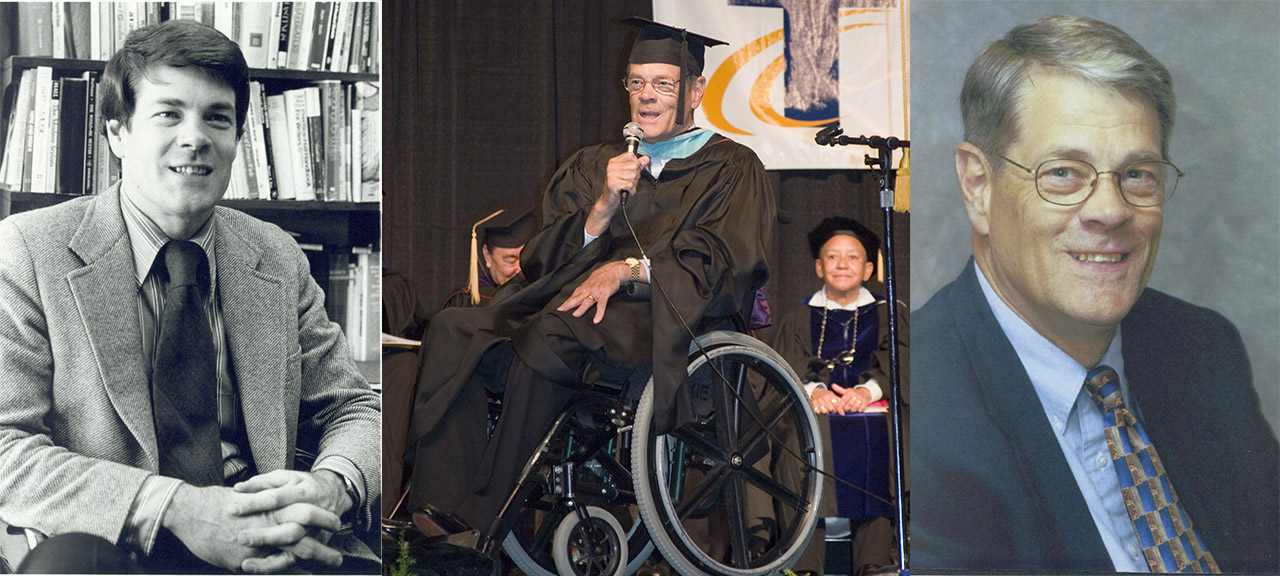
Long-serving TCC English faculty member and Executive Dean of Academics and Student Affairs Frank Garratt passed Oct. 23, 2025.
Teaching and Administrative Career
Born in Pittsburg in 1939, Garratt earned his B.A. in English from the University of Illinois in 1963, and his Master’s in Education from the University of Illinois in 1965. He joined the English department as an original faculty member of the new Tacoma Community College in 1965 and taught until 1978. He served as Chair of the English and Communications division from 1978 – 1980, Chair of Humanities from 1980 – 1984, and Executive Dean of Academics and Student Affairs from 1984 to his retirement in 1998. TCC awarded him an honorary degree in 2006.
Teaching and Leading from the English Department
Garratt’s former colleagues remember him with great fondness. During his years as a professor, English department faculty members and their students would attend potlucks, plays, and the Oregon Shakespeare Festival together.
“Didn't everybody love Frank? I know I did. I have so many stories,” said retired TCC English Professor Georgia McDade. “I met him the first day I came to TCC for an interview, May 5, 1970. I loved talking to him, especially about the literature, any literature.”
McDade said that Garratt developed a composition exercise which she uses in writing workshops to this day.
“Students were required to analyze their own writing: variety of verbs, types and length of sentences. Everybody's writing improved.
TCC English Professor Emeritus Richard Wakefield, who was hired when Garratt was Dean of Academics and Student Affairs, described Garratt’s influence on the college as “wide and deep.”
“He would come by my office now and then to ask what I was doing in class, how it was going, and what I would like to do. It took me a while to realize that he wasn't checking up on the new kid. He was genuinely interested,” Wakefield said.
“Despite his position and history with the college, he wasn't trying to make sure things continued as he had started them but, rather, to make sure that the faculty — and therefore, of course, the students — were engaged, inspired, and thinking ahead. It's remarkable that, as invested as he was in the college, he wasn't inclined to insist that things be done in the same old ways. His investment was in learning, not in a legacy of methods and protocols.”
Wakefield maintained a lifelong friendship with Garratt and his family and is grateful to have encountered Garratt early in his teaching career.
“Our long talks about poetry, drama, and fiction left me feeling that I had something important to share with our students. Something that would make their lives better, just as it had made his and mine better. It was my great good fortune to have him play a part in the early years of my career.”
English Professor Ken Fox also considers Garratt an important friend and mentor.
“During my first year at TCC (fall 1997), I was given a faculty mentor, and mine was Frank Garratt. It was Frank's last year at TCC, and he was spending it in the classroom teaching,” Fox said.
“What started as a mentoring relationship quickly became a friendship that lasted all these years since. TCC felt like a soft landing in so many ways because I had Frank's insights, wisdom and support that first year. Our kids all remember having dinner at Frank and Carol's and Frank sneaking them out on the deck to fire off his potato gun (more of a cannon, really). I remember that first advising day watching Frank. All the students lined up and Frank talking to each one in a personal, careful way. Taking his time and really listening. They were advisees he met with just once a quarter, but he knew their names, and he gave every one of them his time and attention. It was a teaching lesson I never forgot.”
Launching a College
"The college hadn’t really opened yet, it had no students,” Garratt said during his TCC 50th Anniversary interview. “I got a letter from the college president, Thornton Ford, saying, when you get into town come up to the college and check it out, before classes start.”
Garratt recalled that there was no landscaping of any kind; he simply drove up to the door of the administration building, got out of his car, and went in. After clearing up the Dean of Students’ initial misconception that he was a student there to register for classes, he was hired.
“The atmosphere early on, as I’m sure others have said – it was pretty much like a family,” Garratt said. “I think the spirit of the place was pretty much, we would do anything to get it going and get it off the ground and make it successful.”
Changing with the Times
Garratt said that in the early years, the two biggest issues facing TCC were race relations and the Vietnam war. During his TCC 50th Anniversary interview, he reflected on the late 60s and their impact on the college.
“It was just a difficulty time. You know, you basically have an all-white faculty, very earnest in its effort to be accepting, at the same time being asked to accept things that were just so foreign to them and to their experiences,” Garratt recalled. “And what the faculty was being asked to do, what I was being asked to do, was foreign to our experience, which tells you how much justification those students had.”
Prompted by the student-led Obi Society, TCC began to adjust to meet the expressed needs of its student body. Disruptive by nature and necessity, the adjustments sometimes resulted in clashes between students and faculty.
“We had a number of students on campus who were upset, angry and who didn’t see themselves or their history reflected in the courses that were being taught, and they had a faculty who didn’t see a heck of a lot wrong with that,” Garratt said. “It was a difficulty time, but it was a time we needed to go through.”
Moving into Administration
Though he enjoyed teaching, Garratt gradually drifted towards administration. Essentially, he said, he became an administrator because people kept asking him to do administrative tasks. He stepped in as Chair of the English Department one spring quarter when a colleague became ill. When that colleague was unable to return to work in the fall, he stayed on.
“That was sort of my career in administration in a nutshell – I was asked to do this and asked to do that,” Garratt said. “I was asked to take these administration positions by the college president, so I said, OK, I’ll do that. And then I eventually go to the point where – if you get to the Vice President responsibility, you’re pretty much saying goodbye to teaching for a while.”
Joining the administration required mental adjustments. Instead of asking himself which of his colleagues he’d like to have a beer with after work, he began asking himself which strengths they’d bring to their departments. Instead of looking at instruction in terms of classes, quarter to quarter, he started looking at how programs were likely to perform years into the future.
Garratt’s administrator mindset was challenged during the early 1980s, when hard economic times forced him to participate in draconian decisions about which programs to cut. But despite the difficult times, Garratt was glad that he accepted the challenge to take on administrative work. He spent his first 13 years teaching, then spent 13 years in administration, and he was able to return to the classroom for his final seven years.
“I loved teaching, and I knew I could go back to it, so I thought, this is a really interesting opportunity, and I was very glad I did it. I learned a lot of things being an administrator you’d never learn as a teacher.”
Helping TCC Grow Into Its Potential
Garratt noted that every year, students arrive at TCC because it’s their only option for further schooling. And every year, some of those students surprise themselves.
“Every faculty member I’m sure have stories of students who came here to take a class and ended up getting a degree, going on to a four-year school and they had no real – I wouldn’t say intention – they had no conception that that’s what might be available to them.”
He was happy to see the campus grow over the decades, from the two-building campus that existed when he started, to a point where its appearance more accurately reflects its importance to students and to the city of Tacoma.
“The college has, you know, it’s blossomed. It’s sort of a cliché, but physically it’s much more prominent than it was in those days, and I think its physical prominence is matched by its contribution, which is also more prominent. Most of the students early on were interested in just transferring, and it’s got so much more to offer.”